Categories
Earth from Space Geology Space Exploration

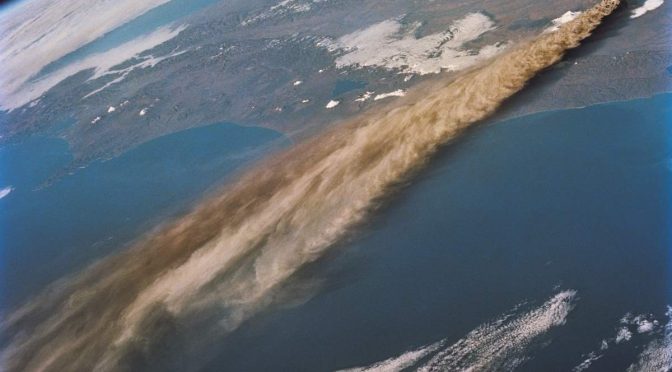
Kliuchevskoi Volcano from Space (NASA Image)

During the STS-68 mission (September 30-October 11, 1994), the crew members of Space Shuttle Endeavour used a 70 mm camera to photograph Klyuchevskaya Sopka (also known as Kliuchevskoi), a stratovolcano, the highest mountain on the Kamchatka Peninsula of Russia and the highest active volcano of Eurasia. The eruption was new when this photo was taken. It was photographed from 115 nautical miles (213 kilometers) above Earth.

Categories
Prehistoric Animals Evolution Geography Geology Insects Life on Earth Planet Earth Plants

Here’s What did Ancient Earth Look Like

I stumbled upon an amazing web page showing what did ancient Earth look like. On the “Dinosaur Pictures and Facts” web page (dinosaurpictures.org), there’s also an interactive animation. On this page, you can either select the years (i.e. 600 million years ago) or jump to a particular event (i.e. first multicellular life) and see how ancient Earth did look like then. You can also remove the clouds and stop the Earth’s rotation if you want to.

Categories
Geography Oceans Places Planet Earth

7 Most Remote Places on Earth

How far away can you get from everybody else on Earth? The answer is “actually quite far”, there are a lot of extremely remote places left in the world and some of them have actually yet to be reached by anybody in all of history. The world is an enormous place. Here are the most remote places on Earth.

Categories
Earth from Space Life on Earth

“One Strange Rock” Trailer

We live on a strange rock… and nobody realizes that better than astronauts. A new documentary, including astronaut experiences of looking down at Earth from space, is coming to National Geographic Channel soon. The award-winning American filmmaker and writer Darren Aronofsky, the American actor, producer, rapper, comedian, and songwriter Will Smith, and experienced astronauts join forces to tell the extraordinary story of why life as we know it exists on Earth. Premieres March 26 on the National Geographic Channel. Here’s the trailer of the “One Strange Rock” documentary.

Categories
Solar System Planet Earth

The “Synestia Theory” says the Moon was formed 1,000 years earlier than Earth

According to a new study, the Moon might have been formed a thousand years earlier than Earth. The new “synestia theory” suggests a Mars-sized object smashed into the proto-Earth. The “giant impact” vaporized about 10 percent of the rock and liquefied the rest, and created a rapidly spinning donut-shaped mass of vaporized rock called “synestia”. The synestia eventually shrunk and cooled. Computer models demonstrated that the Earth subsequently emerged about 1,000 years after the moon.

Categories
Animals Evolution Life on Earth

20 Amazing Lion Facts

The Lion (Panthera leo) is the second-largest cat in the world, after the tiger. The lion and tiger are closely related and they share a very similar body type. As its scientific name suggests, Lion is one of the five members of the Panthera genus (see notes 1). Here are 20 amazing lion facts.

Categories
Geology Geography Planet Earth

Here’s how Earth will look in 250 million years [video]

Earth’s outer shell is divided into multiple plates that slowly glide over the mantle. The movement of these plates slowly changes Earth’s surface over time by merging, or separating, continents. 250 million years from now, consistent with the supercontinent cycle (see notes 1), there will be a possible future supercontinent called Pangaea Ultima.

Hypothesized by Christopher Scotese, a geologist at the University of Texas at Arlington, Pangaea Ultima earned its name from its similarity to the previous Pangaea supercontinent, which was formed about 335 million years ago, and began to break apart about 175 million years ago. Here is a beautiful video published by the Tech Insider channel showing the formation of this supercontinent and how Earth will look 250 million years from now.

Categories
Life on Earth Animals Places

The Man Who Flies With Migrating Birds

Using a two-seater ultralight aircraft built by himself, Frenchman Christian Moullec flies with migrating birds since 1995. In that year, dubbed the “birdman“, Moullec, saw that lesser white-fronted geese were struggling with their migration from Germany to Sweden. Inspired by the work of the famous Austrian ethologist Konrad Lorenz (see notes 1), known as “the man who walked with geese”, he decided to help them and built his handmade aircraft.

Today, if the weather permits, he flies with birds almost every day and guides them through their journey. This stunning footage published by National Geographic shows Moullec, “the man who flies with migrating birds” guiding the flocks of vulnerable species in his ultralight and taking enthralled passengers with him. According to National Geographic, he takes tourists up to fly with birds from March through October.
Categories
Planet Earth Astronomy

Age of the Earth: Our Planet is 18 Galactic Years Old

How old is the Earth? This question preoccupied first philosophers, then scientists, for many centuries. Today, we know that the age of the Earth is approximately 4.54 billion years, with an error range of about 50 million years (4.54 × 10⁹ years ± 1%). This number is based on evidence from radiometric dating of the oldest-known terrestrial rocks as well as lunar rock samples (see notes 1) and meteorites.

Categories
Climate Earth from Space Places

Snow In Sahara, World’s Hottest Desert